
On 4 September 2025, ESPORG met with representatives of European Commission Executive Vice-President Minzatu’s Cabinet in Brussels to advance the wellbeing of professional drivers across Europe. The meeting was attended by Annukka Ojala, Member of Cabinet responsible for occupational health and safety and Francesco Corti, Member of Cabinet responsible for labour mobility, social security coordination, labour markets, and transport.
ESPORG General Manager Dirk Penasse underlined the organisation’s role in advancing safe and secure truck parking, emphasising its vision to transform parking areas into smart hubs that support both logistics and driver welfare.
“The shortage of safe parking and rest areas is not just a logistical challenge — it is a social one,” Dirk Penasse said. “Drivers deserve secure places where they can rest, recharge and feel respected. Their wellbeing is essential to the sustainability of the entire transport system.”
Recent research underscores the urgency of the issue: the EU faces a shortfall of nearly 390,000 safe and secure parking spaces, expected to rise to 483,000 by 2040. This shortage directly affects drivers’ health, safety, and recruitment into the profession, with surveys highlighting concerns over inadequate rest facilities, safety risks, and emotional strain. Addressing these issues was at the heart of the discussions, as stakeholders stressed the urgent need for stronger policy action and investment.
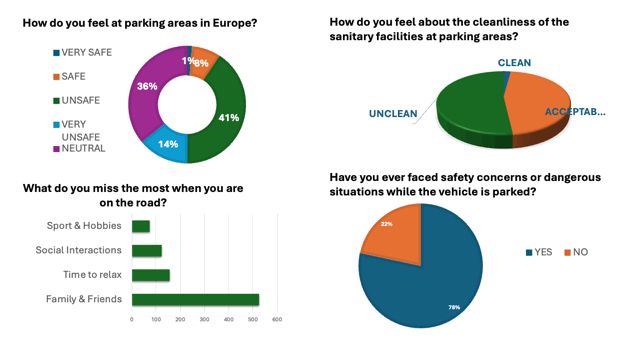
Findings from ESPORG’s survey highlight the scale of the challenge. Out of 966 proffessional drivers from 22 EU countries, many reported difficulties on the road:
- 78% have faced safety concerns or dangerous situations
- 41% felt unsafe in European parkings.
- More than half judged sanitary facilities to be unclean or only acceptable.
- Above all, drivers reported missing family, friends, and time to relax during long journeys.
To address these challanges Druselia Betea, head of the European Wellbeing Initiative (Ewellin), presented the programme “Drive Safe, Park Safe, Work Safe, Live Well.” The initiative introduces tools such as a Wellbeing Label to recognize the companies’ effort for improving working&resting conditions , wellbeing training for transport and logistics, and the establishment of a Wellbeing Specialist role within the sector.
“Investing in drivers’ wellbeing means investing in safer roads, better recruitment and retention, and a more resilient transport sector,” Druselia Betea said.
ESPORG also invited the Cabinet members to endorse the Wellbeing Pledge and join upcoming events, including the Wellbeing Conference in Bucharest this October.
By placing driver wellbeing firmly on the European policy agenda, ESPORG aims to support European Commission’s efforts to foster safer, healthier, and more sustainable working conditions for Europe’s professional drivers.