
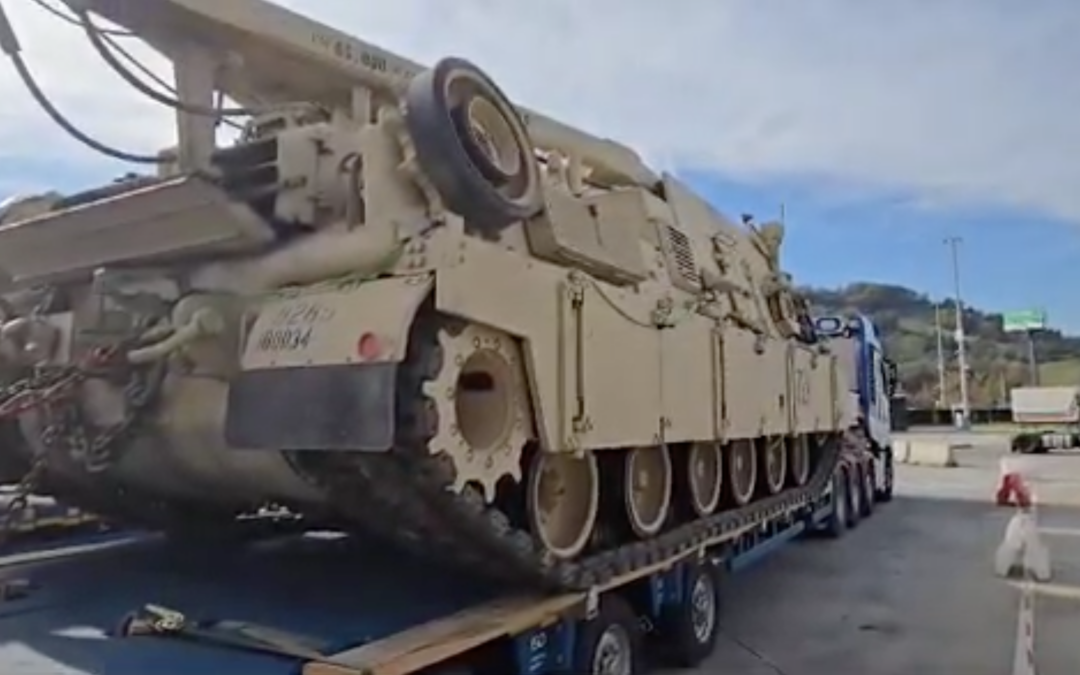
At first glance, discussing the role of secure parking areas in military mobility may seem complex and difficult to grasp. In simple terms, military mobility is about ensuring that troops, vehicles and equipment can move quickly and efficiently across Europe, especially in times of crisis. Just like trucks in logistics, military convoys need safe places to stop, rest, refuel and organize. This is where Safe and Secure Parking Areas (SSPAs) come in. For parking operators, this means that their sites could play an important role not only for drivers and goods, but also in supporting Europe’s security and emergency preparedness.
As policymakers, military representatives and transport leaders gathered in Brussels for the ESPORG Annual Conference 2026, a clear message emerged: in the context of military mobility, parking is no longer peripheral — it is essential. In this evolving landscape, Safe and Secure Parking Areas are emerging as a strategic component of Europe’s resilience and defense preparedness.
As Dirk Penasse, General Manager of ESPORG, set out clearly: “Safe and Secure Parking Areas are no longer simple rest areas along Europe’s roads. They are evolving into strategic service hubs, embedded in Europe’s transport resilience, energy transition, digital supply chain transparency, and increasingly, military mobility.”
This transformation reflects a broader shift. What was once considered supporting infrastructure is now being recognized as part of the ecosystem enabling both civilian logistics and military operations.
A new strategic reality for Europe
Europe is entering a new phase in how it thinks about mobility. The challenge is no longer just about moving goods efficiently, but about moving military personnel and equipment quickly, safely and at scale across borders. This requires more than roads. It requires secure parking places to stop, organize, and support movement – as emphasized during the high-level panel on Military Mobility at the ESPORG Annual Conference.
Herald Ruijters, Deputy Director-General, Directorate-General for Defense, Industry and Space (DG DEFIS), European Commission, highlighted that military mobility has become a critical capability for Europe’s security and deterrence. In today’s rapidly changing geopolitical context, large-scale military movements require proper staging along key corridors, underlining the importance of the dual-use infrastructure, where investments primarily serve civilian transport but must also ensure readiness for military needs. In this view, close cooperation between EU institutions, Member States, NATO and infrastructure providers — including secure parking operators — is crucial to develop common standards, improve capacity and ensure preparedness across Europe.
Parking Areas as new strategic “hot spots”
At the political level, this role is now clearly acknowledged.
Roberts Zīle, Vice-President of the European Parliament, emphasized the importance of integrating infrastructure such as secure parking areas into Europe’s military mobility framework: “We are working to establish a clear European framework to facilitate the transport of military equipment, goods and personnel across the Union, removing unnecessary obstacles and improving digitalisation. From our perspective, infrastructure elements such as safe and secure parking areas can form part of critical ‘hot spots’ along these routes, supporting military mobility. At the same time, there is strong demand for additional investment, but resources will remain limited, so we must also ensure that what is developed contributes effectively to operational needs and resilience.”
From movement to deployment: the military perspective
From the military point of view, the discussion went further, highlighting the operational implications of Europe’s evolving mobility framework.
Brigadier General Stefan Lampl, Logistics Director at the European Military Staff, stressed the importance of the upcoming Military Mobility Package 2.0: “Europe must move from permission-based peacetime movement to pre-approved rapid crisis mobility. If the next year succeeds in speeding procedures, protecting infrastructure, and funding key upgrades, military mobility will significantly strengthen European deterrence.”
He also underlined the need to adapt infrastructure to military realities:“Many European roads, bridges, railways, and ports were built for civilian use — not for 70-ton tanks or large armoured convoys. Military Mobility 2.0 supports upgrading dual-use infrastructure so it can handle heavy armoured vehicles, large military transports, strategic airlift and port logistics. This benefits both military and civilian transport systems.”
Crucially, General Lampl highlighted the role of parking areas as Convoy Support Centres: “Convoy Support Centres (parking areas) are a critical enabler for fast and secure military deployment. They provide secure locations for personnel to rest and recover during long movements. They also enable vehicle maintenance, refuelling, logistical, and medical coordination to ensure convoys remain operational and on schedule. By offering security, support, and flexibility, these centres help troops and equipment reach their destinations quickly and safely. Nations are responsible for integrating the centres into their national deployment plans.”
Dual-use parking infrastructure for civilian logistics & military mobility
The discussions also highlighted a key concept shaping EU policy: dual-use infrastructure. Safe and Secure Parking Areas are designed primarily for civilian logistics, but are increasingly expected to support military needs in both planned and emergency scenarios.
Under the EU Military Mobility framework, parking areas may be required for the Host Nation Support operations and also to provide priority access during emergencies.
In practice, this means that a facility designed for truck drivers today could tomorrow become part of Europe’s crisis response system – EMERS. This evolution requires preparation, alignment of standards and clear communication between all stakeholders.
As Dirk Penasse explained: “Truck parking areas — particularly certified Safe and Secure Parking Areas — are already occasionally used for military logistics.. However, we currently lack a harmonised legal framework, clear operational procedures and structured cooperation between authorities and private operators. This preparation must happen before a crisis — not during one.”
A question of readiness — and shared cost responsibility
An important message from the ESPORG panel was that military mobility requires the involvement of private infrastructure operators and the broader logistics ecosystem. Investments will be needed to upgrade infrastructure, align standards and train personnel. These efforts must be supported by dedicated public funding and clear policy frameworks.
As highlighted by ESPORG General Manager Dirk Penasse during the discussion: “Private parking operators cannot be expected to bear the financial burden of military preparedness alone. The obvious negative cost-benefit ratio between private investment and military mobility obligations must be addressed and public funds must be made available for private entrepreneurs, including for dual-use safe and secure parking areas, to fully bridge the negative cost-benefit gap”.