
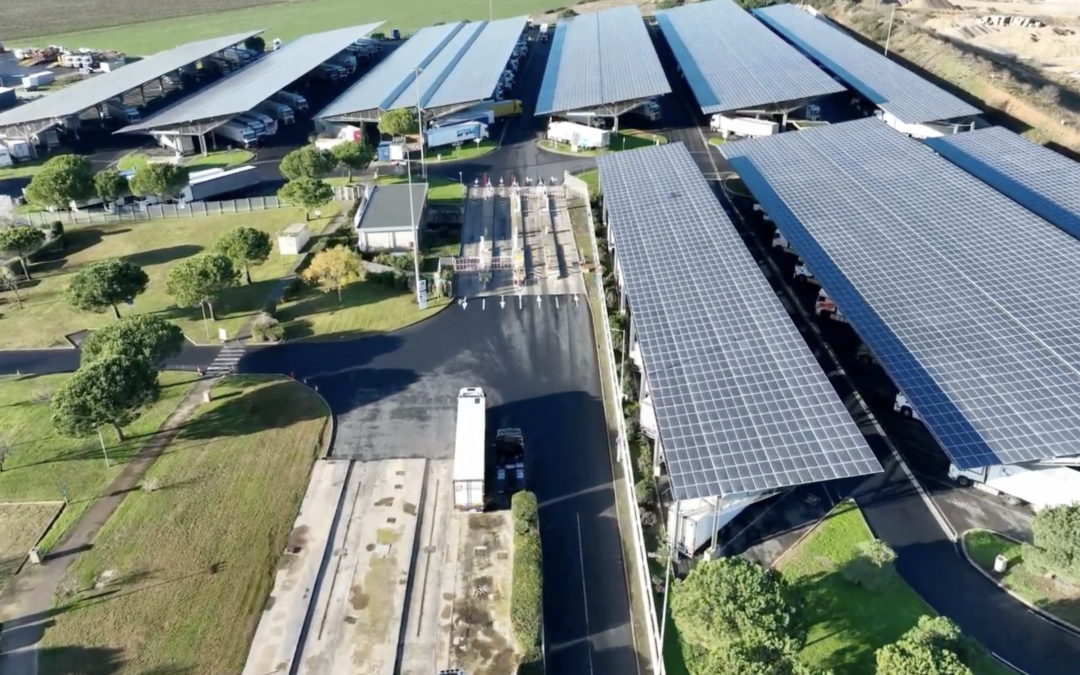
Europe’s road transport sector is undergoing a profound energy transition—and truck parking is emerging as a critical enabler of this shift. No longer just places for rest, the safe and secure truck parking areas (SSTPAs) are evolving into strategic infrastructure that supports electrification, decarbonisation, and the EU’s climate neutrality ambitions.
At ESPORG’s workshop “Energy Transition – Green Parking Standard”, held on March 4, 2026, policymakers, industry leaders, and operators came together to explore how parking infrastructure can become a key facilitator of sustainable transport.
From Parking Areas to Energy and Logistics Hubs
A central theme throughout the discussions was the need to rethink the very role of parking infrastructure. Rather than serving a single function, future parking areas are expected to integrate energy, logistics, and digital services into one cohesive ecosystem.
The European Commission reaffirmed its commitment to supporting this transformation—particularly through the integration of charging infrastructure and the evolution of regulatory frameworks.
As Filip-Alexandru Negreanu-Arboreanu (DG MOVE) emphasized: “European Commission would like to support the development of electric charging within safe and secure parkings, because this adds to the qualitative nature of the parking as a hub in road transport. We will be launching this year a reflection on the revision of the Delegated Act 2022/1012 detailing the level of service and security of safe and secure parking areas, because as technology advances and electrification progresses, we will need to address those aspects that would make the delegated act more applicable to the future needs of hauliers and for you as developers of parking areas as well.”
Energy Transition – Where Do We Stand and Where Do We Want to Go?
While policy sets direction, implementation presents real challenges—particularly around energy infrastructure. Integrating charging infrastructure into parking areas raises questions around timing, investment strategies and technical constraints such as grid capacity.
From an operator’s perspective, the transition is no longer theoretical—it is becoming a strategic decision point that requires immediate attention and informed planning.
“The question for operators isn’t if, but when to get serious about charging integration. Whether starting small or leaping forward, seeking expertise through partnerships will be crucial to navigating market dynamics and avoiding grid bottlenecks.” said Koen Noyens (MILENCE).
This shift also reinforces the importance of collaboration across the ecosystem. Rather than developing isolated solutions, stakeholders are increasingly exploring shared infrastructure models that optimise resources and reduce costs. By partnering to create publicly accessible hubs at secure parkings, we can replace individual depot needs with efficient, shared infrastructure. At the same time, Nicolas Buteau (EDF) mentioned that affordability remains critical—especially for SMEs. It was underlined the need of innovative models such as ‘charge-as-a-service’ leasing, allowing operational costs to be spread over the infrastructure’s lifetime to make the transition feasible.
Marco Digioia (UETR) stressed that for transport operators, predictability and flexibility are essential. Operators need certainties now: reliable cross-border charging, fair taxation on alternatives like HVO, and policies that support all viable low-emission options to keep Europe’s road transport competitive.
For shippers, sustainability is no longer driven solely by regulation—it is becoming a competitive differentiator, shaped by customer expectations and supply chain requirements. Godfried Smit (ESC) noted that sustainable real estate in parking areas isn’t just an option—it’s a CSR imperative that can attract major shippers and transport companies seeking end-to-end green logistics chains.
From a system-wide perspective, infrastructure planning emerges as a critical success factor. Without early coordination—particularly with energy providers—the transition risks being slowed down or fragmented. Michael Nielsen (ESPORG Chairman) underlined that Safe and secure parkings must evolve into energy hubs, but early grid planning and collaboration is essential to make green transitions practical.
Industry takes the lead – the Green Parking Standard
In response to these challenges, ESPORG introduced the Green Parking Standard as a practical tool to guide operators through the transition. As Frédéric Maas (ESPORG) explained, the Green Parking Standard represents ESPORG’s proactive initiative to drive sustainability in truck parking. Importantly, the framework encourages operators to adopt a broader, more integrated approach to sustainability—one that generates value across the entire transport ecosystem. By integrating the Green Parking Standard, key challenges like energy management and electric charging can be addressed from the ground up, ensuring that safe and secure parking areas become hubs for innovation and environmental responsibility
As explained by Oleg Kamberski (ESPORG), the Green Parking Standard is a voluntary addition to EU safe and secure truck parking certifications, incorporating more than 40 criteria to define and promote sustainability in parking management and operations. Developed in close partnership with DEKRA and a panel of industry experts, this standard defines what truly makes a parking ‘green,’ from decarbonization elements to innovative practices, ensuring it’s achievable for any committed operator.
The Green parking standard certification has been designed to be both rigorous and accessible. “Aligned with the EU’s climate neutrality target by 2050 and interim goals for 2030 and 2040, the Green Parking Standard supports the transport sector in advancing sustainability through practical, voluntary measures.The certification integrates seamlessly with SSTPA audits in a single on-site visit, making it efficient and cost-effective with auditors trained for both processes” – said Peter Paul Ruschin (DEKRA).
“Collaboratively crafted with parking practitioners, the Green Parking Standard is realistic and feasible. Green Parking Pilots revealed that many parkings already excel in areas such as effective waste management and LED lighting; the green parking standard provides guidance to build on these strengths and explore further improvements.” added Carla Lüps (DEKRA)
Green Parking Leaders Proving It Works
Concrete examples from across Europe demonstrate that the transition is already underway. Early adopters are showing that sustainability measures can be implemented in diverse contexts—delivering both environmental and economic benefits.
“Participating from Eastern Europe, where green concepts can be challenging to adopt, we adapted the standard with efficient supply chains and community support, proving its effectiveness.”,” said Florin Vlăduţ (Smart Autohof Pecica).
In France, operators are combining environmental innovation with improvements in driver wellbeing—highlighting the human dimension of the transition. “We’ve installed charging infrastructure and low-carbon fuels to partner with customers on their sustainability journeys. Now, all our electricity comes from renewable sources, evolving us from simple infrastructure providers to key contributors in the future of transport.These eco-friendly improvements also benefit drivers’ daily lives.”explained Karina Marty (Truck Etape Béziers / Truck Arena 31).
Meanwhile, in Spain, circular economy practices are unlocking new efficiencies and strengthening relationships with local communities. ““Some green actions require minimal investment, like managing and monetizing waste through reuse or sales, while others involve operational changes that yield long-term savings. The Green parking standard empowers us to exceed regulations with features like water reuse and acoustic barriers, promoting savings and positive neighborhood relations.”,” said Adela Olano (Mowiz TRUCK Astigarraga).
The workshop concluded with the certification of the first Green Parking leaders, from four European countries – France, Romania, Spain, Denmark:
- Delta Park Dourges
- Le Shuttle Freight Village
- Truck Arena 31
- Truck Etape Béziers
- mowiz Truck Astigarraga
- Smart Autohof Pecica
- OnTurtle La Jonquera
- Recharge City
“These inaugural certificates represent a significant milestone for sustainable transport; our pioneers are leading the way, inspiring many more to follow” said Dirk Penasse (ESPORG).
Learn more: https://greenparkingstandard.eu/
For a practical, peer-learning, showcasing proven approaches to safe, secure, and sustainable truck parking – join ESPORG webinar Excellence in Truck Parking: Best Practices on 26 March 2026.