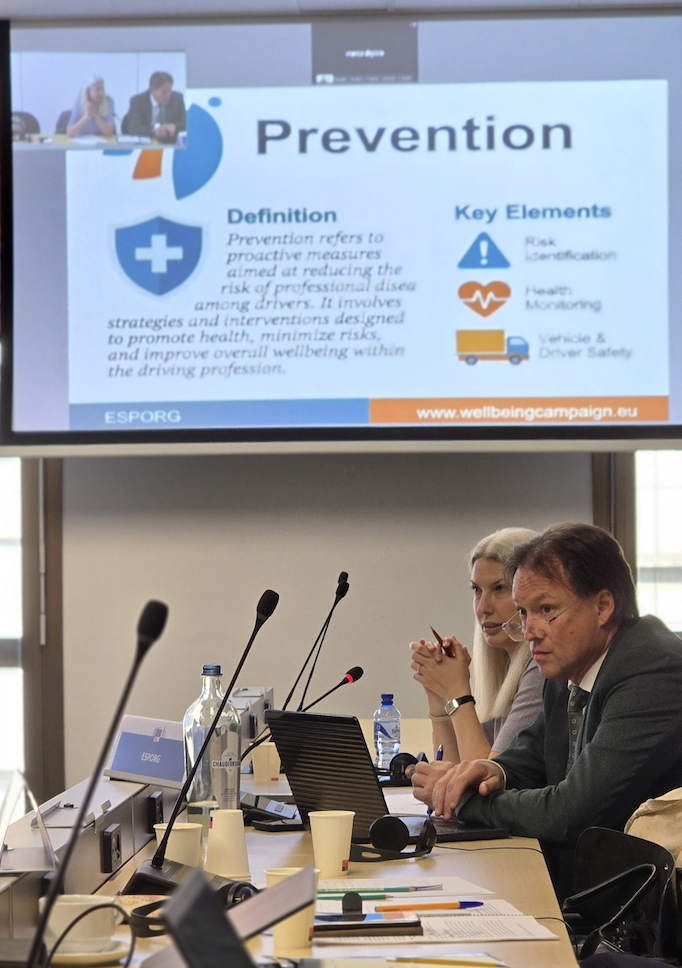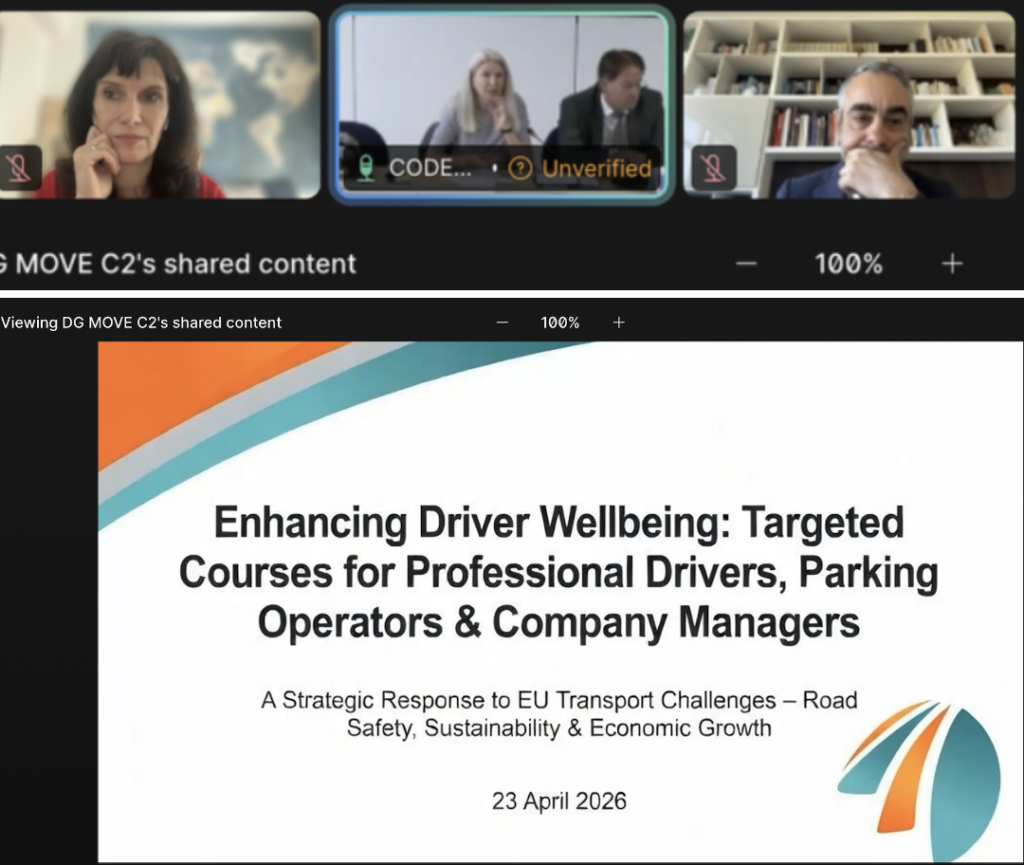
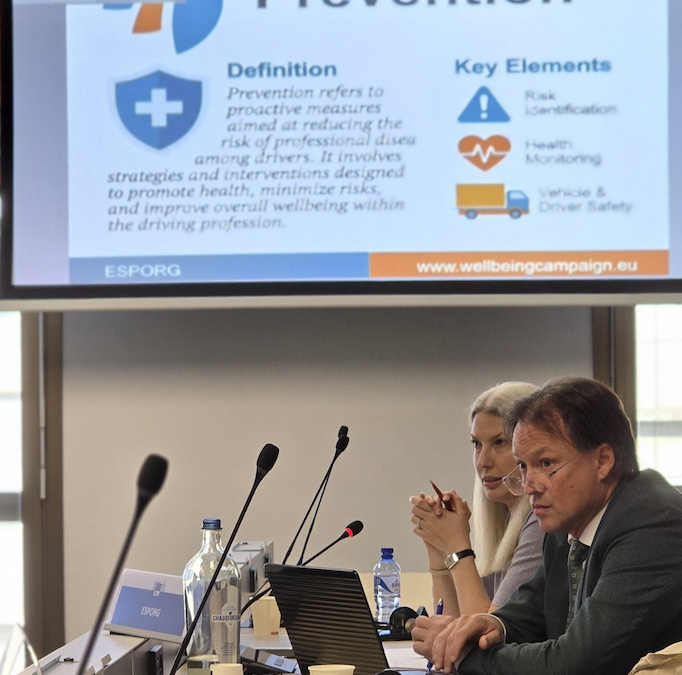
On 23 April 2026, representatives of the European Secure Parking Organisation (ESPORG) actively contributed to the European Commission’s CPC Expert Group meeting, presenting the ESPORG Driver Wellbeing Program as a forward-looking response to the challenges facing Europe’s road transport sector.
During the afternoon session, ESPORG’s General Manager Dirk Penasse, together with Druselia Betea, Head of the European Wellbeing Initiative (Ewellin), delivered a comprehensive presentation outlining how structured wellbeing training can enhance road safety, improve working conditions, and strengthen the attractiveness of the profession.

The initiative and its strong positioning at EU level were made possible thanks to the support of the Wellbeing Policy & Regulatory Engagement Task Force (TF), led by Marco Digioia, UETR Secretary General, alongside Dirk Penasse, ESPORG General Manager. Their leadership has been instrumental in advancing the policy dialogue and promoting the wellbeing training at the EU level.
Marco Digioia (UETR) and Manuel Picardi, First Vice-President and Secretary General of EFA European Driving Schools, also attended the meeting and actively supported the Driver Wellbeing Training Program, reinforcing the broad industry commitment behind the initiative.
Wellbeing training – Strategic Response to EU Transport Challenges
ESPORG highlighted that the European road transport sector is currently facing acute pressures, including a growing driver shortage, ageing workforce, and increasing operational stress. The data presented showed that hundreds of thousands of driver positions remain unfilled across Europe, while demanding working conditions continue to impact both safety and retention.
The ESPORG Driver Wellbeing Program directly addresses these issues through a comprehensive training ecosystem, consisting of three interlinked courses targeting:
- Professional drivers
- Secure parking operators
- Transport managers
This integrated approach ensures that wellbeing is embedded across the entire logistics chain, rather than treated as an isolated issue.
Alignment with driver training legislation
A central focus of ESPORG’s intervention was highlighting how the Driver Wellbeing Program aligns with — and strengthens — the requirements of the EU legislation on the initial qualification and periodic training of drivers.
The EU CPC Directive already includes key elements such as:
- Prevention of physical risks (ergonomics, fitness, safe movements)
- Awareness of physical and mental fitness (fatigue, stress, nutrition, rest cycles)
These elements are directly addressed and operationalised within the ESPORG training framework .
In its formal communication to the European Commission, ESPORG proposed explicitly integrating driver wellbeing as a structured subject within CPC training, under the categories of health, road safety and working conditions .
Link to Safe and Secure Parking Areas (SSPAs) – Wellbeing hubs for drivers
A distinctive feature is the integration of SSPAs as wellbeing hubs, promoting:
- Rest quality
- Access to healthy food and physical activity
- Social connection and recovery
This directly supports EU policy priorities on parking infrastructure and driver rest conditions.
EU Industry-Wide Commitment
The initiative is powered by ESPORG and builds on the Wellbeing Pledge for Drivers, now supported by more than 150 signatories from across the transport ecosystem – including authorities, drivers’ organisations, transport companies, insurers, shippers, and service providers. It was launched with the support of European Commissioner for Sustainable Transport and Tourism Apostolos Tzitzikostas.
ESPORG participation in the CPC Expert Group marks an important step towards embedding wellbeing into the EU regulatory framework — transforming it from a complementary concept into a core competence for the transport sector.
As the industry faces unprecedented challenges, ESPORG’s Driver Wellbeing Program demonstrates that investing in people is not only a social imperative, but also a strategic necessity for a safer, more resilient and sustainable European transport system.
ESPORG invites all stakeholders to explore the European Wellbeing Initiative at www.ewellin.eu and sign the Wellbeing Pledge www.wellbeingpledge.eu