
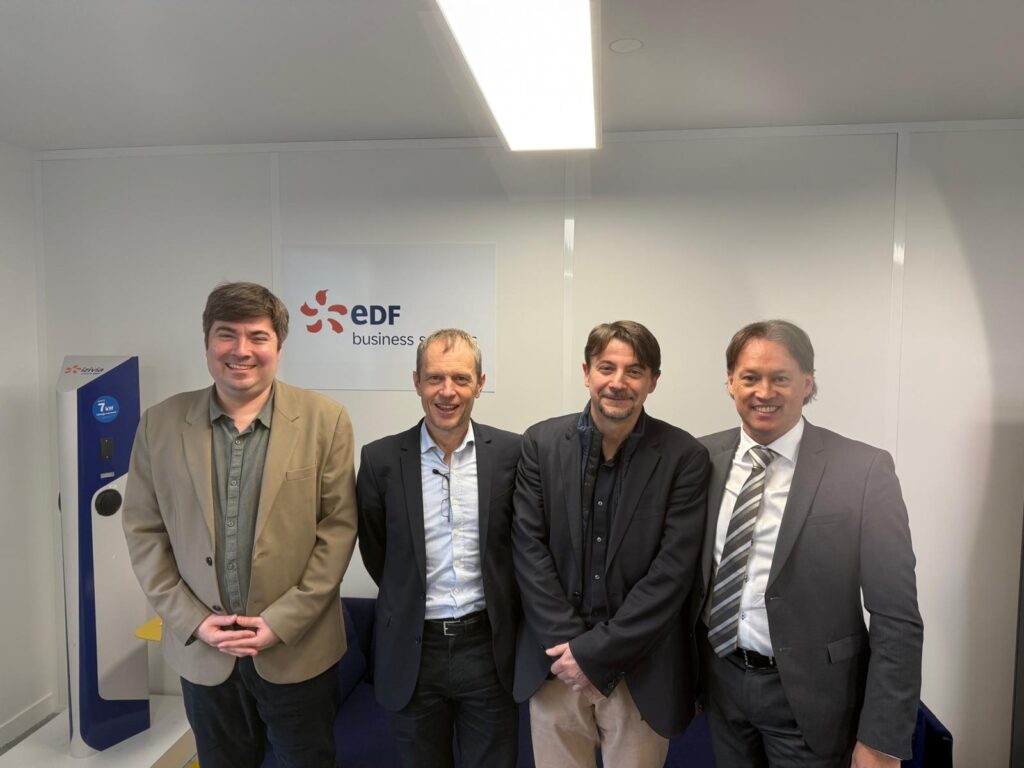
EDF – major energy player in France and a key player in Europe’s e-mobility has strengthened the collaboration with ESPORG by joining as technical partner. This collaboration represents a major advance in preparing Europe’s road transport infrastructure for the energy transition. Secure truck parking areas are rapidly transforming into multimodal energy hubs equipped for charging, renewable integration and sustainable services. EDF’s deep expertise in electric mobility and grid solutions will support speeding up the adoption of the voluntary Green Parking Standard.
“We are proud to have EDF as a technical partner. EDF’s involvement underscores the growing link between parking infrastructure and the energy transition, preparing the sector for a more sustainable future,” said ESPORG General Manager Dirk Penasse.
EDF Leadership in e-Mobility – Driving ESPORG Green Parking Vision Forward
France’s leading electricity company and a key European low-carbon energy player, EDF offers extensive experience in e-mobility. Eighty years after its creation in 1946, EDF remains a key player in the major collective challenges of our time. By transforming the energy system, the Group is helping reshape the landscape at the crossroads of climate, industrial and societal issues. EDF Group provides comprehensive charging networks, ultra-fast stations for heavy-duty vehicles, smart charge management, and custom financing packages.
EDF’s « White Paper “Électrifier le transport routier de marchandises – Une solution efficace de décarbonation” (2025) » serves as a valuable reference. “Electric energy brings numerous benefits to road freight transport and now makes it possible to electrify the vast majority of missions — while improving the environmental performance of transport and remaining economically competitive.” said Axel Nicolas Le Meignen, Directeur Mobilité Électrique EDF and Jean-Philippe Laurent, directeur stratégie et développement, pôle Client, services et territoires d’EDF.
The Alternative Fuel Infrastructure Regulation (AFIR) mandates the installation by 2030 of high-power charging stations along the TEN-T network: every 60 km on the core network and every 100 km on the comprehensive network. EDF White Paper on freight road transport electrification stresses that two major types of charging coexist and must be considered in a complementary way:
- Depot charging suited to long parking periods, generally at night
- On-the-road charging relies on the deployment of accessible infrastructure, particularly on major motorway routes. It raises specific challenges: station layout, availability of charging points and sufficient power, etc.
Nicolas Buteau, Directeur du Développement Entreprises, EDF – Direction Commerce Méditerranée, said: “Electrification shouldn’t come at any cost—we must prioritize practical solutions like depot charging for shorter routes, ensuring viable business cases for operators of all sizes. To support small transport companies, which make up 85% of the market, we need innovative models like ‘charge as a service’ leasing, spreading OPEX over the infrastructure’s lifetime to make the transition feasible.” “Heavy-duty vehicles manufacturers are already offering vehicle leasing; extending this to charging infrastructure will be transformative, aligning costs with long-term usage for a smoother energy shift.” – added Nicolas Buteau.
Safe and secure parking areas (SSTPAs) certified under the EU Parking standard are perfectly placed as publicly accessible energy hubs. They offer a practical alternative to individual depot setups — particularly important for the road freight sector where the majority is composed of small and medium sized companies. According to EDF White Paper, several players, such as Milence – an ESPORG member or Izivia subsidiary of EDF Group, are actively working to develop fast-charging stations specifically designed for heavy-duty vehicles. These stations are mainly located at strategic points along major transport corridors or near logistics hubs. The developments also focus on station layout to allow trucks and semi-trailers to manoeuvre easily around the charging points.
As the EU driving and rest time rules for professional truck drivers also require a 45-minute break every 4.5 hours of driving, EDF White Paper underscores the opportunity to recharge without impacting productivity: on average, a 45-minute recharge on a 400 kW charger allows recovery of up to 300 kWh, which equates to approximately 300 km of range for a truck consuming 1 kWh/km. In the future, this will be even greater with chargers and heavy-duty vehicles capable of supporting 700 or 800 kW.
The Green Parking Standard with four progressive levels (Green, Advanced, Accomplished, and Excellent Master Green Parking) – remains ESPORG’s forward-looking tool to help companies embrace efficient, eco-friendly practices fully in step with the energy transition. The standard encourages parking operators to incorporate electric charging, renewable energy, smart energy management, and emissions tracking in a flexible, voluntary framework adapted to regional realities.
By teaming up with ESPORG, EDF provides valuable know-how to address grid connection issues, optimise charging installations inside certified SSTPAs, and create attractive business models. With EDF as technical partner, ESPORG community benefits from a strong ally capable of co-developing solutions ranging from innovative “charge-as-a-service” models to seamless high-power charging in secure parking settings. The outcome will be quicker uptake of the Green Parking Standard, more robust business cases for operators, and concrete steps toward the EU’s climate neutrality goal by 2050.
Operators interested in the Green Parking and charging solutions are invited to contact ESPORG at info@esporg.eu.