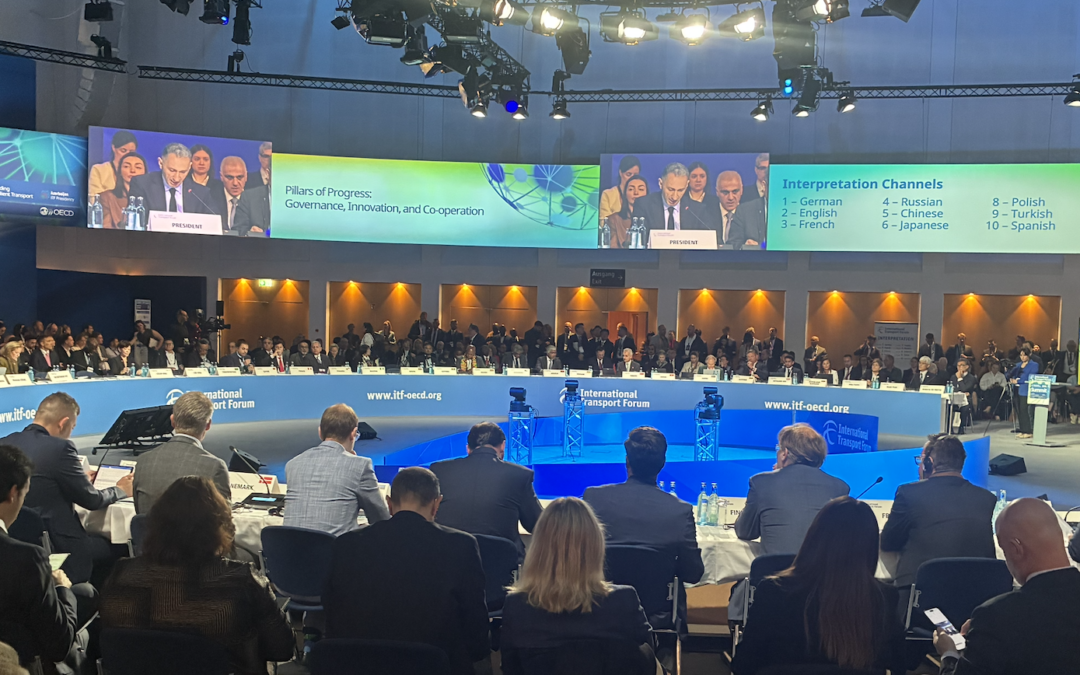
ESPORG attended the International Transport Forum (ITF) 2026 Summit, the world’s largest gathering of transport ministers and a premier global transport policy event, which took place from 5 to 8 May 2026 at the Congress Center Leipzig, Germany. Organised annually by the ITF (an intergovernmental organisation with 72 member countries following the admission of Ghana, Peru, and Panama), the Summit marked the 20th anniversary of the ITF.
Summit participation has grown to over 1 200 participants from more than 80 countries, well beyond the 72 member countries of the ITF. It increasingly attracts business participants, with CEOs joining high-level discussions and companies presenting their work in the Summit exhibition or sponsoring the event. The annual meeting of the ITF Corporate Partnership Board is held as part of the Summit.
The event was held under the Presidency of Azerbaijan and featured a rich programme of ministerial sessions, stakeholder dialogues, expert discussions, technical tours, exhibitions, and side events.
The overarching theme was Funding Resilient Transport” —focused on building resilience in transport systems amid geopolitical, economic, climate-related, and other disruptions.
Program highlights
Over 36 sessions and more than 100 speakers addressed topics such as resilient supply chains, alternative corridors, digital public infrastructure for mobility, and future-ready design integrating physical and digital solutions:
– Ministerial roundtables on governance/funding, freight connectivity, and resilient resource-efficient transport.
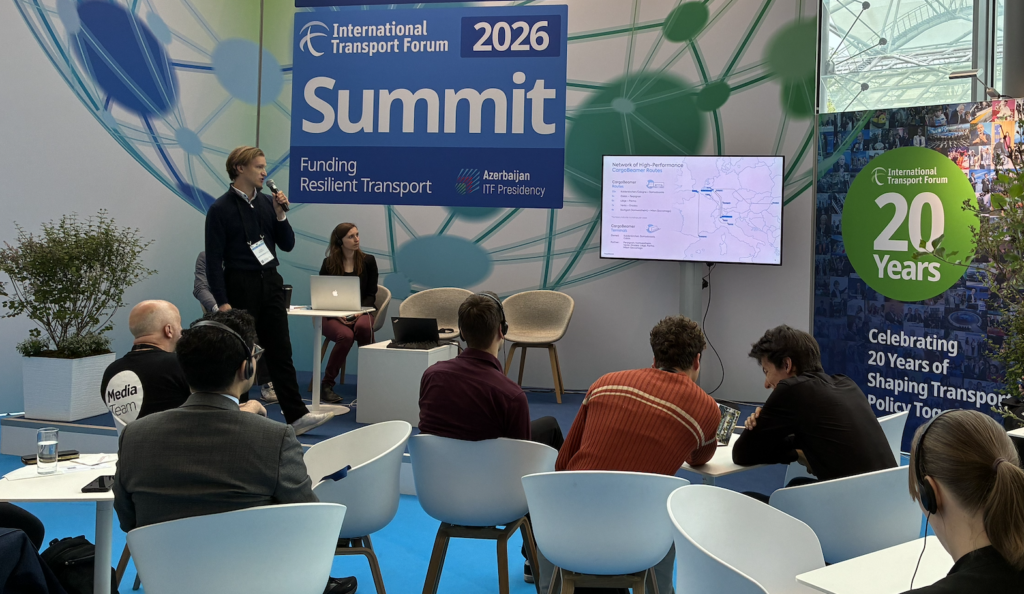
– Summit’s Open Stage Café – a marketplace for new ideas and projects within the exhibition area and stands including transport ministries from UK, Germany, Netherlans, Ukraine, China, ITF and global industry organisations in the field of transport and road safety
– ITF Spotlight on Research Sessions: Focused on physical infrastructure resilience, digital infrastructure resilience and cybersecurity resilience.
– Discussions on supply chain resilience, alternative routes/corridors, and digital public infrastructure for mobility.
The Summit focused on freight connectivity, cross-border logistics, urban mobility, digitalisation and infrastructure resilience, including:
- Mobilising investments and financing strategies to strengthen resilience (physical, digital, and cybersecurity) in transport infrastructure and operations.
- Enhancing long-term connectivity, efficiency, reliability, and supply chain resilience.
- Digital transformation, AI in transport, urban mobility challenges, freight connectivity, and inclusive/net-zero pathways.
- Digitalisation of freight transport and cross-border logistics.
- Development of resilient multimodal transport corridors (Eurasian middle corridor)
- Safe and secure logistics infrastructure and border crossing facilities.
- Road-rail intermodal terminal development(truck parking) and logistics efficiency.
- Urban wellbeing and transport-related quality of life.
- Training projects for women in transport.
Insights from ITF Sessions – the relevance for secure parking
- strategic importance of the Trans-Caspian Transport Corridor (Middle Corridor) linking China, Central Asia, the Caucasus and Europe. Expected growth of freight volumes by 2040 demonstrates increasing demand for secure and resilient logistics infrastructure along major transport corridors, whree secure parking should also be considered.
- Road-rail terminals: role of parking: the integration of rail and road freight systems creates new requirements for secure truck staging and parking infrastructure around terminals. Efficient intermodal operations require driver support services, secure waiting areas and digital traffic management.
- Wellbeing, quality of life and Human-Centric Mobility, addressing social inclusion, quality of life and the human dimension of transport systems. The European Wellbeing Initiative powered by ESPORG is a concrete industry campaign advancing these objectives.
Policy Recommendations adopted by ITF Summit
On 7 May 2026, during the Council of Ministers of Transport (18th Session), ITF Ministers adopted two important Policy Recommendations representing strong political consensus to guide national policies and foster international cooperation:
– ITF Policy Recommendation on the Digitalisation of International Freight Transport Connectivity
This document provides concrete guidance to accelerate the digital transformation of cross-border freight systems. It highlights how digitalisation can reduce transit times, improve supply chain resilience and reliability, enhance visibility of cross-border flows, support trade competitiveness, economic growth, and regional integration. It aims to strengthen international freight connectivity through digitalisation; highlights reduced transit times, supply-chain resilience/reliability, visibility of cross-border flows:
- safety/security standards,
- Frameworks for digital transport documentation
- dedicated public investment programmes& integrated funding models
- cooperation between stakeholders and along transport corridor.
-Policy Recommendation on Urban Transport Development
This Recommendation emphasises the role of urban transport in improving quality of life amid growing urbanisation. It addresses urban transport quality, smart and digital systems, new mobility services and planning frameworks by:
- strategies, standards and guidance for smart traffic management,
- new mobility services on congestion, emissions,
- funding options for public transport infrastructure
- plans for urban mobility in alignment with national and sub-national planning frameworks
The ITF Summit highlighted the importance of cooperation between public and private stakeholders in building more resilient, sustainable and people-centred transport systems. In this context, secure parking for professional drivers is an essential component of transport resilience, supply chain continuity and driver wellbeing across Europe.