
In the heart of the European quarter, inside the European Commission’s Borschette Building in Brussels, a different kind of transport conversation unfolded this year at the ESPORG Annual Conference on 4 March 2026. Not one dominated by tonnage, routes or efficiency metrics—but by people.
At the Drivers’ Wellbeing panel discussion, the spotlight shifted firmly onto those who keep Europe moving: the truck drivers.
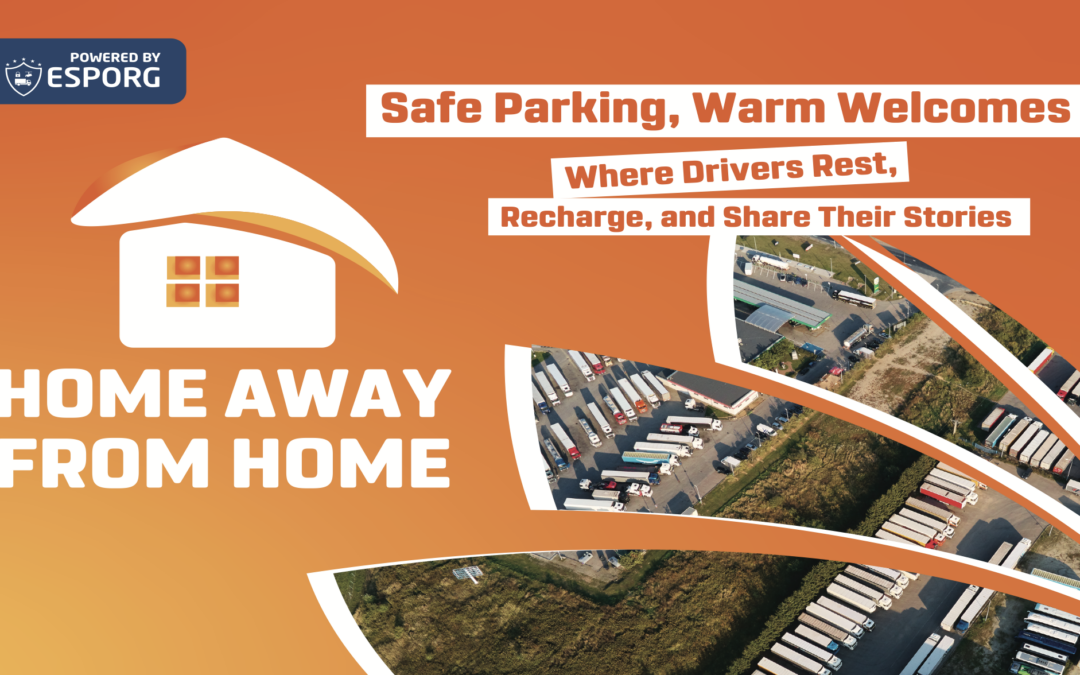
The event marked the launch of the second year of ESPORG’s ambitious Wellbeing Campaign—“Drive Safe, Park Safe, Work Safe, Live Well.” If the first year raised awareness, the second is both simple : “Park Safe” and innovative, by introducing the Home Away from Home concept.
A New Chapter: From Parking Spaces to Home Away from Home
Under the theme “Safe Parking, Warm Welcomes: Home Away From Home – Where Drivers Rest, Recharge and Share Their Stories,” ESPORG is calling for a cultural shift—one that embeds empathy into logistics.
Truck parking areas are no longer seen as mere infrastructure—they are becoming spaces of comfort, dignity and connection. Because behind every delivery is a person who needs rest, safety and a sense of belonging.
The Human Side of Logistics
Throughout the drivers’ wellbeing panel discussion, one narrative resonated time and again: the lived experience of drivers.
The long hours on the road.
The uncertainty of finding a safe place to stop and the risks on road safery.
The essential need of arriving somewhere clean, secure, and welcoming.
And, just as importantly—the quiet moments of connection. A conversation over a warm meal. A shared story in a lounge. A space that feels, even briefly, like home.
As Druselia Betea, Head of the European Wellbeing Initiative (EWELLIN), put it:
“Home away from home is not a place — it’s a feeling.”
It is a feeling built through meaningful details: well-lit parking, clean facilities, respectful staff and environments that restore dignity and reduce isolation.
A Sector at a Turning Point
The urgency behind this initiative is clear. Europe’s road transport sector is facing a critical shortage—around 500,000 unfilled driver positions. Behind that number lies a deeper issue: the declining attractiveness of the profession.
Speakers across the conference were unanimous—working conditions must improve if the sector is to survive and thrive.
Ambassador Cosmin Boiangiu, Executive Director of the European Labour Authority, emphasized the link between infrastructure and workforce sustainability:
“Driver´s wellbeing depends on the quality, availability and security of parking infrastructure. We cannot ignore the reality that the shortage of drivers is becoming one of the most serious labour market challenges in European transport. Improving working conditions is therefore essential not only for fairness but for the resilience and competitiveness of Europe’s transport system..”
Francesco Corti – Member of the Cabinet of Executive Vice‑President Roxana Mînzatu at the European Commission reinforced this message, highlighting that fair mobility must also mean dignified conditions:
“Labor mobility should be free, but it must also be fair—fair for companies, fair for workers and fair for the authorities responsible for enforcing the rules we have in place. If the workers in the EU road transport sector do not have access to safe and secure parking areas, in this case we cannot truly speak about good working conditions for the sector. Without adequate facilities, working conditions deteriorate, and with them the attractiveness of the sector..”
Beyond Infrastructure: A Collective Responsibility
From motorway operators to labour unions, from shippers to policymakers, a shared understanding emerged during the ESPORG Conferece’s panel discussion: driver wellbeing is a collective responsibility.
Malika Seddi – Secretary General of ASECAP, the European association of toll motorway operators reminded participants that drivers are the backbone of Europe’s economy, while Sven Hemelaers Coordinator for Road Transport & Logistics at BTB‑ABVV (Belgian Transport Workers’ Union) stressed the importance of fair working conditions and wages alongside infrastructure improvements.
Jordi Espin Vallbona – Secretary General of Transprime (Spanish Shippers’ Council) brought the perspective of shippers, pointing to the need for better conditions at delivery sites, ensuring that wellbeing is embedded across the entire supply chain.
This is the essence of the “Home Away from Home” concept— transforming not just truck parking areas, but the entire supply chain – extending welcoming atmospheres beyond parking facilities to every touchpoint in a driver’s journey.
Among the standout examples was Bapaume Truck House in France, awarded this year for excellence in truck parking. Its manager, Thierry Roger, captured the spirit of the movement:
“Logistics runs on people, not just trucks.”
Facilities like Bapaume and Truck Etape Béziers- winner of the newly-established ESPORG Home Away from Home Award, are proving that safe, secure, and welcoming environments are not aspirational—they are achievable.