
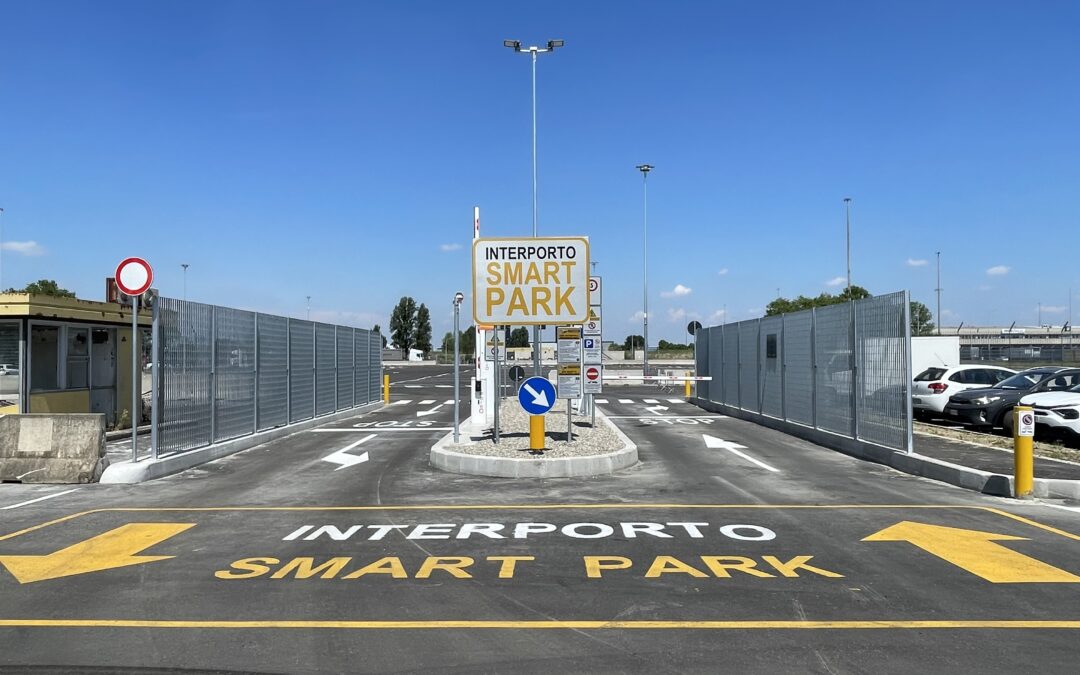
The shortage of safe and secure parking areas continues to represent a structural challenge along the European road transport network. Despite increasing attention at policy level, the availability of certified facilities remains uneven across the TEN‑T corridors, with implications for cargo security, driver safety and operational planning.
Within this context, the development of Smart Park Interporto Bologna reflects an approach increasingly observed across major logistics nodes, where parking infrastructure is designed in alignment with European standards and integrated into broader service ecosystems.
Smart Park Interporto Bologna is certified as a Safe and Secure Truck Parking Area (SSTPA) at Bronze level, confirming compliance with recognized European criteria in terms of safety and service provision. The certification responds to a widely acknowledged gap in the network, where the limited availability of secure parking exposes vehicles and cargo to elevated risks, particularly along high-intensity freight routes.
The facility is located within the Interporto of Bologna, a major intermodal platform positioned at the intersection of several TEN‑T Core Network corridors. This positioning places the parking area within a high-density logistics environment, where road, rail and intermodal operations converge and where the need for reliable stopping points is particularly relevant.
Designed to accommodate 170 heavy goods vehicles, the parking area is enclosed, monitored and accessible through controlled entry systems, with continuous surveillance and lighting. These characteristics are consistent with the requirements associated with SSTPA certification and contribute to addressing risks linked to cargo crime and unauthorized access
Beyond security features, the integration of services represents another dimension of interest. The parking facility provides access to dedicated amenities for drivers, including sanitary facilities, showers and rest areas, alongside connectivity services. While such elements are increasingly considered essential, their availability remains limited in many parts of the European network.
The broader Interporto environment further expands this service dimension. Logistics-related infrastructure such as customs offices, truck washing facilities and fuel distribution — including alternative fuels such as HVO and LNG — are located in close proximity to the parking area. In parallel, services addressing personal needs, including catering options and access to medical facilities with dedicated programs for drivers, contribute to shaping a more comprehensive service environment.
From an operational standpoint, access to certified parking areas such as Smart Park supports transport operators in planning routes in compliance with EU rules on driving and rest times, while reducing uncertainty related to the availability of suitable stopping locations. This aspect remains particularly relevant along busy corridors, where demand for parking often exceeds supply.
At the same time, the quality of rest conditions is increasingly linked to broader considerations of road safety and working conditions in the transport sector. The availability of secure and adequately equipped areas is therefore part of a wider discussion concerning driver wellbeing and the long-term attractiveness of the profession.
In this perspective, the development of facilities such as Smart Park Interporto Bologna can be understood within the ongoing evolution of the European parking landscape, where the expansion of capacity is progressively associated with certification, service provision and integration within logistics platforms.