
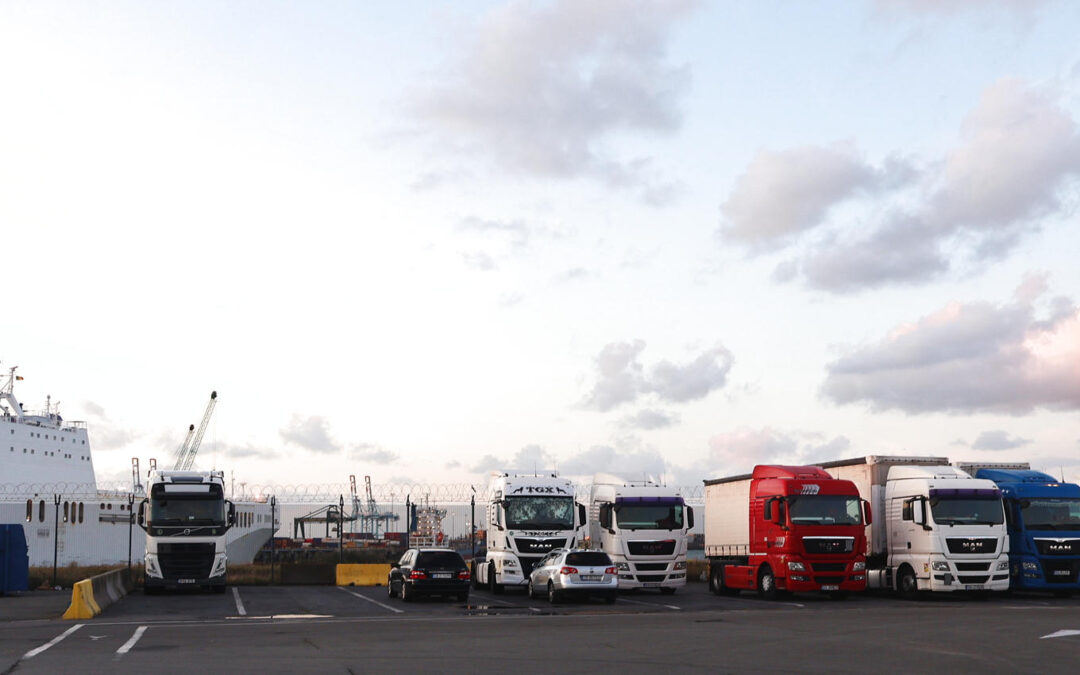
The Flemish Government is preparing a major upgrade of motorway service areas across Flanders, with additional truck parking, improved driver facilities and charging infrastructure among the priorities. The measures form part of the renewed Strategic Network Plan for Service Areas, presented by Flemish Mobility Minister Annick De Ridder – informs Het Belang van Limburg (HBVL).
The plan aims to improve comfort, safety, parking capacity and services across Flanders’ 72 motorway service areas. Thirteen sites are due to be renewed over the next five years, representing a combined public-private investment of more than €100 million, according to the Minister.
One of the projects will be at Tessenderlo, where the service area is being developed with a particular focus on freight transport. The tender is planned for 2027. The Flemish Agency for Roads and Traffic (AWV) requires the project to provide at least 45 additional truck parking spaces towards Antwerp and 21 towards Liège. The blueprint also includes a weighbridge, expanded sanitary facilities and sports facilities for truck drivers.
The plans extend beyond Tessenderlo. Over the next ten years, the Flemish Government intends to create 500 to 800 additional truck parking spaces. According to HBVL, 266 spaces have been added over the past five years, bringing the current total to 2,886.
Future tenders will also require charging infrastructure for trucks. In Limburg, truck charging facilities are planned at Tessenderlo, Diepenbeek and Zolder. Diepenbeek, which was already redeveloped and expanded in 2024, is ultimately intended to become a fully equipped motorway service area with a filling station and shop.
Source: “Vlaanderen vernieuwt snelwegparkings met aandacht voor vrachtwagens: parking in Tessenderlo wordt uitgebreid”, Het Belang van Limburg (HBVL), 25 August 2026.
ESPORG proposes a concrete European funding solution
ESPORG believes that Flanders must raise its ambitions. ESPORG is not only calling for greater parking capacity, but is also putting forward a concrete and financially viable solution.
“ESPORG welcomes the Flemish Government’s increased attention to truck parking, but Flanders must raise its ambitions. The need is greater than the capacity currently planned, and we have a concrete and financially viable opportunity to act. By combining Flemish investment with European co-funding, we can accelerate the development of the safe and secure truck parking capacity that drivers and the logistics sector urgently need,” said Dirk Penasse, General Manager of ESPORG.
For the next Connecting Europe Facility (CEF) call in 2028, Flanders should submit an integrated grant application entitled “Masterplan Flanders – Safe and Secure Truck Parking”.
Under the CEF, the EU can fund up to 50% of eligible investment costs for the upgrading and expansion of existing Safe and Secure Truck Parking Areas and the development of new ones.
“Flanders must make the most of this European funding opportunity.” considers Dirk Penasse.
Such a Masterplan could bring together existing and new projects and focus on:
- the expansion of existing truck parking areas;
- upgrading existing sites to the EU Parking standard;
- developing new Safe and Secure Truck Parking Areas;
- providing additional capacity along the main TEN-T corridors;
- improving the safety of drivers, vehicles and cargo;
- providing sanitary facilities, wellbeing services and high-quality rest facilities;
- providing appropriate infrastructure for female drivers;
- developing charging infrastructure for zero-emission trucks; and
- ensuring digital connectivity and parking availability information.
The truck parking shortage is urgent – Flanders must aim higher
Why roll out a Flemish plan that will create only 500 to 800 additional truck parking spaces over a ten-year period, when Europe could contribute up to 50% towards a much more ambitious catch-up effort?
Flanders must therefore begin preparations now.
During 2026–2027, Flanders could determine actual parking needs along individual transport corridors, evaluate existing sites and identify new strategic locations. Projects can be prepared technically and administratively so that Flanders can submit a dossier that is fully ready for investment in the 2028 CEF call.
This would enable concrete solutions to be implemented within a much shorter timeframe.
This is the difference between planning ahead and playing catch-up.
“The Flemish Government must make use of the European instruments specifically designed to tackle this kind of cross-border infrastructure challenge. Flanders is not an isolated transport region. It is a crucial link in the European TEN-T network and must develop its truck parking policy in line with that European responsibility.” explained Dirk Penasse, ESPORG General Manager.
ESPORG therefore calls on Minister Annick De Ridder to make the 2028 CEF call a strategic priority and to prepare a “Flanders Masterplan – Safe and Secure Truck Parking” in collaboration with the sector.
Tackle the shortfall today, make use of the available European co-funding and build the capacity that Flanders, as a leading logistics region, actually needs.
“Let us not find ourselves playing catch-up in ten years’ time. We must plan today for the mobility of tomorrow.”