
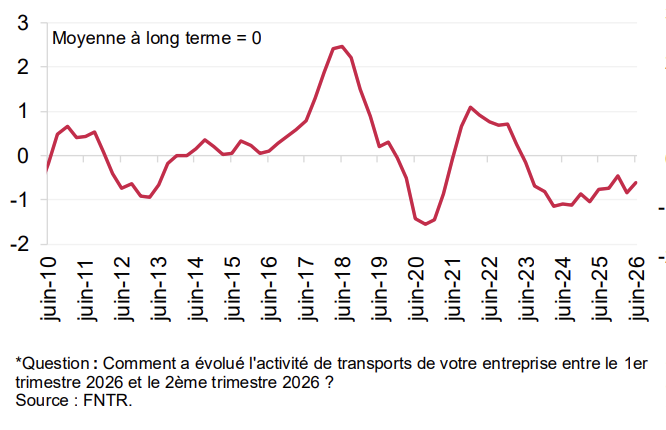
Fédération Nationale des Transports Routiers – FNTR’s Q2 2026 survey points to a fragile stabilisation in French road freight transport following the sharp deterioration recorded at the beginning of the year. While activity has improved slightly and driver employment has stabilised, the Federation cautions that the current situation should not yet be interpreted as a genuine recovery.
FNTR is the voice of French road transport operators and a valued ESPORG partner, actively involved in our shared efforts dedicated to drivers’ wellbeing, to improve their working conditions, road safety and the development of safe and secure truck parking infrastructure in France and across Europe.
FNTR’s Q2 2026 findings
The FNTR published its economic survey for the second quarter of 2026 on 21 July, focusing on road freight transport activity. Following the sharp deterioration observed in the first quarter, the indicators show signs of a partial correction. However, this improvement remains limited and should be interpreted with caution: it comes after a particularly pronounced low point and, at this stage, does not indicate a genuine return to normal.
Recent activity has picked up slightly, expectations have become somewhat less unfavourable, and the number of drivers has stopped declining. Nevertheless, the indicators remain below their long-term average, confirming that the sector remains in a phase of subdued economic activity. The second quarter of 2026 should therefore be seen as a fragile stabilisation following the cost shock experienced at the beginning of the year, rather than as a sign of a lasting recovery.
Road freight transport companies continue to face fragile demand, high costs, pressure on margins and insufficient economic visibility. This situation is leading business leaders to prioritise caution, preserve their cash flow and limit commitments that could increase their financial exposure.
Investment remains very limited and is mainly focused on fleet renewal, with no real momentum towards increasing capacity. This weakness is a major point of concern, particularly as the sector must address the challenges of modernisation, equipment renewal and the energy transition.
On the employment front, the number of drivers has stabilised following the decline in the first quarter. However, this stabilisation does not reflect a structural improvement in the labour market: it mainly reflects companies adjusting to a lower level of activity. Recruitment difficulties remain, affecting 39% of hauliers in April 2026, compared with nearly 41.6% one year earlier.
Business leaders’ confidence also remains very weak. The proportion of dissatisfied business leaders fell from 78% in the first quarter to 55% in the second quarter of 2026, but this improvement should be understood as a correction following a historic low point, rather than as a sign of renewed confidence.
The second quarter of 2026 therefore marks a relative improvement in the road freight transport economic environment, but not a recovery. In this context, the FNTR is calling for greater economic visibility to be restored for companies in the sector. Securing cost pass-through mechanisms, preserving cash flow, ensuring regulatory stability and supporting investment appear to be essential conditions for preventing stabilisation at a low level from turning into a lasting weakening of the business landscape.
Source: Fédération Nationale des Transports Routiers (FNTR), Q2 2026 Economic Survey on Road Freight Transport Activity, published 21 July 2026. Read the original FNTR press release here.