
The 19th DEKRA Road Safety Report, published in 2026 under the title Working in Road Traffic, focuses on the road as a workplace. The report concludes that professional drivers, road workers, emergency responders, and transport operators face growing risks from fatigue, time pressure, unsafe parking, inadequate infrastructure, and increasing traffic volumes, requiring a holistic approach that combines infrastructure, technology, legislation, and driver wellbeing.
Roads remain one of Europe’s most dangerous workplaces
Every day, millions of professional drivers keep Europe’s economy moving, yet many work in conditions where fatigue, unpredictable traffic, insufficient rest opportunities, and demanding schedules significantly increase accident risk.
According to DEKRA, fatigue remains one of the most critical risk factors because it directly impairs reaction time and attention. The report highlights that road crashes remain among the leading causes of fatal workplace accidents in many countries, affecting not only transport workers but also construction crews, emergency services, and other road users.
Jann Fehlauer, Managing Director of DEKRA Automobil GmbH, stresses that improving road safety requires looking beyond vehicles alone: “Safe work zones and construction sites, adequate parking, and reliable organisational workflows are key to eliminating accidents in our everyday working lives.” He adds that lasting improvements can only be achieved through a holistic combination of technical innovation, clear regulations, safe infrastructure, and responsible behaviour.
European Commission: Driver wellbeing is a societal responsibility
Kristian Schmidt, EU Road Safety Coordinator at the European Commission, underlines that protecting professional drivers requires investment across the entire transport system: “Their wellbeing is not merely a workplace issue—it is a duty for our society as a whole.” K.Schmidt highlights EU measures, including mandatory driver fatigue monitoring systems on new lorries and buses, blind-spot detection, and the broader push for a safety culture that integrates occupational health and road safety. According to the EC official: “Targeted investment—in safe and secure parking areas, clearer road signs and markings, or better-designed work zones—systematically reduces the hazards drivers and workers face day to day.”
DEKRA survey reveals the scale of the parking crisis
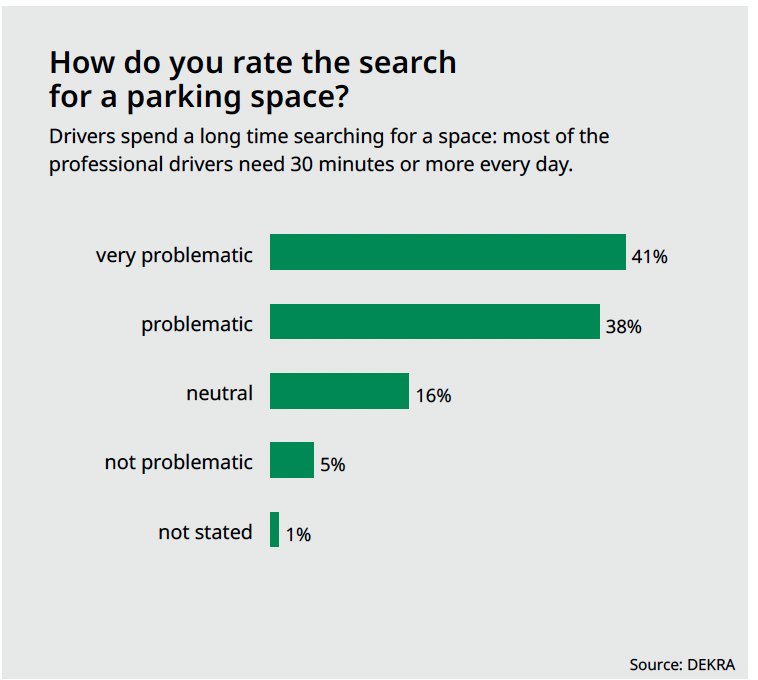
Drivers spending a long time searching for a free space, dangerous evasive manoeuvres, and increasing levels of crime are among the findings of a survey of around 100 professional drivers from different countries that DEKRA conducted for this Road Safety Report. More than half of the participants have been working in the trucking industry for over ten years, making their assessments highly reliable.
The findings paint a stark picture of the parking situation along German and European motorways:
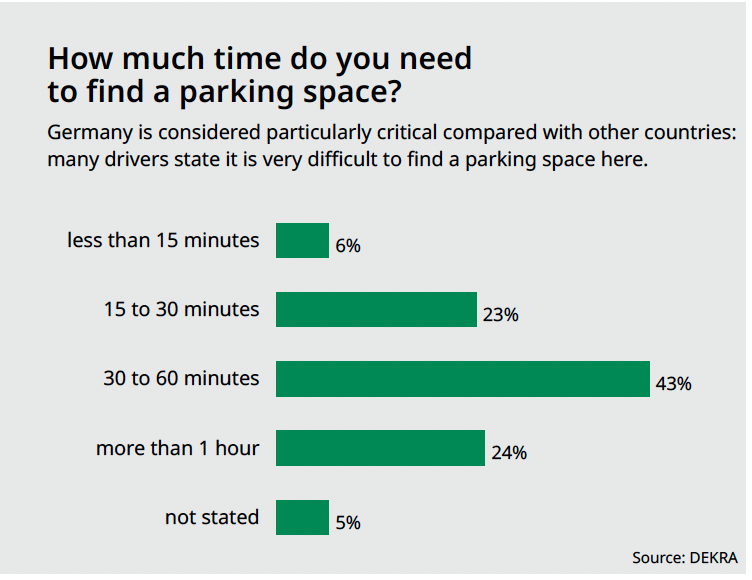
- Searching for a suitable parking space has become a daily struggle for professional drivers: around 43% need 30–60 minutes on average, while a further 24% need more than an hour.
- More than half usually drive more than 20 km extra to find a free space, making compliance with legal driving and rest periods more difficult and increasing fatigue-related risk.
- Almost two-thirds of respondents regularly have to park in potentially dangerous locations, such as entry and exit roads or roadsides.
- Around 60% of drivers identify the lack of video surveillance as the biggest safety and security problem, followed by poor lighting.
- Nearly one-third feel unsafe due to the absence of police or security personnel.
- Almost 50% deliberately avoid certain rest areas because of security concerns.
Germany is rated as the most difficult country in which to find a parking space. Experts estimate that Germany alone still needs around 40,000 additional truck parking spaces on its motorways. Digital platforms that allow advance booking of spaces are already helping, but the structural shortage remains acute. Because drivers often cannot find legal parking before reaching their mandatory rest time, many resort to parking on motorway access roads, exits, and emergency lanes, creating additional safety risks.
The situation is even more challenging for drivers transporting dangerous goods, refrigerated products, animals, and cargo at risk of theft, as they are subject to additional requirements.
Drivers call for more and larger parking spaces, clean, free washrooms, good lighting, video surveillance, real-time digital information, and reservation options. They also express a clear desire for greater respect, better remuneration, and improved working conditions overall.
ESPORG: Safe parking is fundamental to road safety
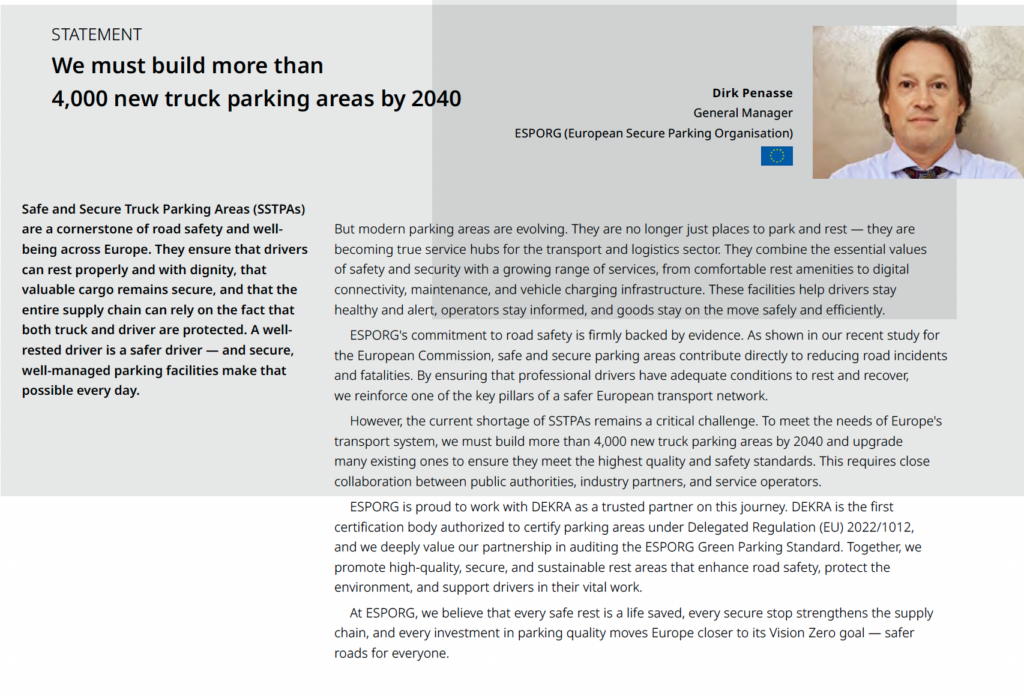
One of the strongest messages in this year’s report comes from ESPORG General Manager Dirk Penasse, who argues that safe and secure truck parking is no longer simply an infrastructure issue—it is a road safety imperative: “A well-rested driver is a safer driver. At ESPORG, we believe that every safe rest is a life saved, every secure stop strengthens the supply chain, and every investment in parking quality moves Europe closer to its Vision Zero goal—safer roads for everyone.”
DEKRA’s demands to improve safety on the road as a workplace
The DEKRA Road Safety Report 2026 sends a consistent message across all stakeholders: improving road safety for professional drivers requires far more than safer vehicles.
Investment in secure truck parking, driver wellbeing, better infrastructure, advanced technology, harmonised legislation, and improved working conditions must all progress together.
DEKRA’s recommendations to improve safety on the road as a workplace explicitly call for:
- Building more safe and secure, well-lit truck parking spaces with video surveillance and real-time availability information across Europe. The lack of such spaces forces drivers into risky improvisation and rule-breaking, increasing accident risk. Secure parking improves both road safety and drivers’ working conditions.
- Mandating the introduction of health promotion programmes for professional drivers, addressing lack of exercise, stress, and sleep deficits.
- Continuing the expansion of medical care networks such as DocStop along major traffic routes.
- Ensuring strict enforcement of, and compliance with, driving and rest time regulations.
The DEKRA Road Safety Report 2026 makes a compelling case that Vision Zero cannot be achieved without treating the road as a workplace. Secure, high-quality truck parking areas and genuine attention to driver wellbeing are not optional extras—they are fundamental safety infrastructure.